What’s it like to be a vampire?

“One of the most important games of life, then, is the game of Revelation, a game played for the sake of the play itself.” L. A. Paul

What is it like to be a vampire? Nobody knows – unless you happen to be one of course! And that’s the whole point according to L. A Paul in her book Transformative Experience. You cannot make a rational choice to become a vampire because you don’t know what it’s like to be one until you are one.

It’s a startling thought experiment which, according to Paul, applies to many real life situations like contemplating parenthood or even a radical change of career. Normative rules of rationality break down here because no matter how much third-person empirical evidence one gathers, one cannot really know what many transformative experiences are like until one has subjectively felt it. Part of her argument is fuelled by a famous thought experiment in which Mary has been incarcerated in a monochrome room all her life. No matter how much information she gathers about colour, she cannot know what it is like to, for example, experience redness until such time as she leaves the room. So too, argues Paul, with many everyday experiences, when rational choice theory breaks down.

Interestingly, and perhaps a little oddly, Paul does not deploy perhaps the most famous thought experiment of them all in this field, devized by Robert Nozick and called the Experience Machine. In this scenraio scientists have invented a virtual reality machine which, once you are plugged in you a) cannot leave and b) gives you a perfectly happy life guaranteed to be happier than ‘real’ life.

Nozick anticipates that most people would choose not to be plugged in, thus demonstrating that there is more to life than happiness. But doesn’t this come up come up against Paul’s Transformative Experience problem? How could you make a rational choice to be plugged into the Experience Machine if you don’t what it would be like to be perfectly happy until you experience it? As Paul puts it ‘if we have to choose to have transformative experiences on the basis of preference revelation, that is, by preferring to discover the preferences we’d develop, then we must prefer to give up any current first-order preferences that conflict with the new preferences we’ll end up with. Many of these first-order preferences may be preferences that we think of, in some way, as defining our true selves’.

Paul refers to the importance of subjective values as being distinct from ‘merely valuing happiness or pleasure and pain’, thus obliquely referencing the Experience Machine. And she adds: “When we choose to have a transformative experience, we choose to discover its intrinsic experiential nature, whether that discovery involves joy, fear, peacefulness, happiness, fulfilment, sadness, anxiety, suffering or pleasure, or some complex mixture thereof.”

Paul’s solution to the problem of Transformative Experiences is to ‘draw on empirical findings when the right sorts of findings are available’. She adds: “But, crucially, in addition to managing the decision-theoretic worries using more sophisticated modelling techniques, resolving the problems raised by transformative experience also involves valuing experience for its own sake, that is, for the revelation it brings.”

The light that Paul shines on transformative experience is valuable but the conclusion is disappointing if all she is claiming is that it can sometimes be interesting to take the plunge and have a new experience. Surely, this is something that we all do from time-to-time while at other times we may be more risk-averse. Much depends, of course, on the nature of the risk. Nothing much hangs on sampling a new culture but Brexit is just the kind of transformative experience that Paul has in mind. Nobody knows what it will be like outside of the EU, despite protestations to the contrary on both sides. Perhaps this was a case where should have been more risk averse simply because we are gambling not with individual lives but with a country.

What’s the point of ignorance?

“The philosopher is the shepherd who tends the mixed flock of the possible on the highlands…” Michael Serres.

What’s the point of ignorance? Well, quite a lot as it turns out. We know that ignorance is everywhere. If we have a problem defining or describing English identity, then some might argue that a good place to start is ignorance. It seems as though some people relish being ignorant, they even wear it as a badge of honour – after all, we’ve had enough of experts haven’t we? Even though we live in an age of unprecedented access to information, we also live in what some people are calling the Age of Ignorance.

As Daniel R. DeNicola writes in his extraordinary book Understanding Ignorance: “Tyrants and other advocates of authoritarian systems have long appreciated the advantages of an ignorant constituency.” By contrast, he writes ‘democracies – at least in theory – rest on the pillar of an enlightened citizenry’ but now ‘the problem of political ignorance…is so severe that the ideal of an informed citizenry seems quaint’.

Such views are commonplace these days. Most people who regard themselves as educated and well-informed decry the seeming advance of ignorance on all fronts. It could be argued, of course, that ignorance has always been with us and that in days gone by it was much worse. But maybe the difference today is that, rather than being a stigma or something to be ashamed of, ignorance, at least in some quarters, is regarded as being almost a matter to be proud of, something to be celebrated – as epitomized by the drooling troll.

But Understanding Ignorance goes much further than these commonplaces to argue that ignorance is a permanent state of humanity and, indeed, the force behind our search for knowledge or, as DeNicola prefers to call it, understanding.

Almost inevitably, DeNicola draws on what he calls ‘Rumsfeldian parsing’ – that is 1) known knowns 2) known unknowns 3) unknown unknowns, and the one that Rumsfeld left out 4) unknown knowns, which refers to knowledge that is, or has become, subconscious, like riding a bike. These referents were not invented by Rumsfeld, of course, but were summarized nearly a decade before him by the philosopher Ann Kerwin. It is the unknown unknowns that attracts DeNicola most, including his most piercing metaphor of the horizon of ignorance. In this world he also uses simile when he describes knowledge, or understanding, as being akin to an unstable island in a sea of ignorance as far as the eye can see. But at least as we cast our nets over the sea we may gain new understanding or find new islands to colonize. We may even move towards the horizon, but as we do, of course, the horizon also moves and what lies beyond is the unfathomable, boundless emptiness of unknown unknowns. Even if we move beyond our immediate horizon into space our knowledge is bounded by the observable universe, that which is determined by the length of time it has taken for light to reach us – and so on.

In this context DeNicola writes of what he calls ‘improved ignorance’. We may refine our ignorance by ‘specifying more precisely a known unknown but in the process new questions open up that could not even have been asked before and were therefore unknown unknowns and now become known unknowns. The point here is not that the vast region of unknown unknowns has been reduced, only that our horizon of ignorance has shifted.

It is in this horizon of ignorance – which, incidentally, emphatically rejects some scientists’ claim that there will one day be a theory of everything – that the philosopher thrives. He writes that ‘genuine philosophical understanding recognises an ultimate escape from ignorance as an impossibility, a vain attempt to clutch the horizon’. We should introduce a word of caution here because, although the horizon metaphor is a powerful one, it does not in itself express the truth of the matter. One could argue, for example, that since what lies beyond the horizon is unknown unknowns DeNicola cannot possibly state with any certainty that it, or at least most of it, cannot come with the purlieu of human understanding. At the same time, however, our experience of quantum physics, which famously no-one truly understands, and our exploration of the vastness of the universe (or universes!) does lend weight to DeNicola’s central claim.

But DeNicola is no apologist for ignorance and in the final pages of this important book – which is only 208 pages long but itself contains enough insights to fill its own universe – DeNicola returns to what he earlier calls ‘socially constructed ignorance’ and appeals to an ‘epistemology of resistance’. Specifically, he writes: “The appropriate response is now coalescing: a shift from the individual knower to the epistemic community, with a correlative shift from epistemic autonomy to forms of epistemic dependence.” And then this powerful plea: “Social epistemologists of varying stripes have brought attention to sources and forms of socially constructed ignorance, to the privileges and power that permit certain types of wilful ignorance, and to the need for an ‘epistemology of resistance’ that reveals and disrupts structures of epistemic oppression.”

This book is erudite and important, treading warily at times and sometimes boldly the porous boundary between our fragile and ever shifting knowledge and the seemingly infinite field of ignorance. It would be depressing if it did not combine a celebration of the knowable with ‘the horizon of the unknowable’ and a call to arms against the construction by the powerful of wilful ignorance.

Understanding Ignorance is published by The MIT Press.

Dickie Bellringer.

What’s the point of boredom?

Well, not much really – but it turns out that it’s quite interesting to find out how and when it arises.

According to Iain McGilchrist in The Master and his Emissary boredom is a result of ‘unnatural detachment’ characteristic of the left hemisphere of the brain. Indeed, the whole book is an epic exploration of the battle between the left and right hemispheres. Traditionally, the left hemisphere has been seen as the rational side and superior to the frippery of the right. However, McGilchrist turns this view on its head, so to speak, arguing that that the right side is the more holistic, organic and insightful, and should actually be the senior partner while the left should be seen as its invaluable analytical servant.

Just as an example of his argument – and it should be said that the book covers a huge range of topics and adduces a vast amount of evidence to support his case – he writes that the left’s need for certainty leads to ‘devitalisation’. The author draws on the work of Patricia Spacks in her book Boredom: the Literary History of a State of Mind in which she makes the claim that boredom arose in the 18th century and relates it to ‘the dreariness of non-engagement’. Now, as with so much of McGilchrist’s book, one has to be cautious here. Spack’s book is about the literary manifestation of boredom and is not a sociological treatise. Taking her too literally produces absurd claims that boredom didn’t exist before the 18th century. But, with that caveat in mind, McGilchrist goes on to write: “I would connect the rise of the concept of boredom with an essentially passive view of experience; a view of vitality as mediated by novelty, a stimulant force which comes from the outside, rather as the power supply comes to the computer.” His reference here to a computer is particularly apposite because it doesn’t take a huge leap of the imagination to understand how the modern person seems to crave external stimulation, whether it be from television through to the continual absorption of social media and self-confirming algorithms. It’s the sight of the modern zombies, plugged in and head bowed in silent homage to the tech giants as they check their ‘phones – completely oblivious of the real world around them and rendered stupefied by the external stimulant.

McGilchrist makes his point most clearly when he writes: “Devitalisation leads to boredom and boredom, in turn, to sensationalism.” And again: “Since the rise of capitalism in the 18th century, when according to Patrician Spacks boredom as such began (and here we need to recall the earlier caveat), an appetite for the new and the different, for fresh experience and novel excitement has lain at the heart of successful bourgeoise society, with it’s need above all to be getting and spending money.” This analysis seems to speak to our times as McGilchrist builds his argument that the Servant (the left side) is making a play to take over the Master (the right). There is a sense in which McGilchrist appears to refer to the two sides of the brain as though they were two characters in a book or play, and this takes on an epic, and possibly strained, sweep when he scales this up to involve such movements as the Reformation, Renaissance, the Enlightenment, Modernism and post-modernism. He can also be guilty of cherry-picking at times and this is most apparent when he picks on the two ultra-rationalists Jeremy Bentham and Rene Descartes to make his point, while ignoring those who tend to undermine his case like Voltaire, Hume and D’Alembert. The latter thinker, in response to similar criticisms of the Enlightenment, rejoined: “In sum, even assuming that we might be ready to yield a point to the disadvantage of human knowledge, which is far from our intention here, we are even farther from believing that anything would be gained by destroying it. Vices would remain with us, and we would have ignorance in in addition.” And as Anthony Gottlieb writes in The Dream of Enlightenment ‘because the philosophes repeatedly stressed the weakness of the human mind it is probably misleading to refer to the Age of Reason, which ought to be the Age of Trying to be more Reasonable’, although Gottlieb acknowledges that this would be a less than snappy title.

There is also an element of the ‘just-so’ about the book when his analysis of the relationship between the left and right sides of the brain sometimes just happens to fit his criticism of the modern world.

Nevertheless, and despite some major flaws, The Master and His Emissary makes a seductive case that seems to underpin many of the perceived ills of modernity. It’s the sort of book that needs to be taken as a whole. That does not mean papering over the cracks but seeing them as part of this flawed but majestic edifice. If we follow McGilchrist’s advice and try to read the book with the two sides of the brain working in harmony, then it has the potential to be, if not life-changing exactly, then definitely perception-shifting.

Is Liberalism dead? Was it ever alive?

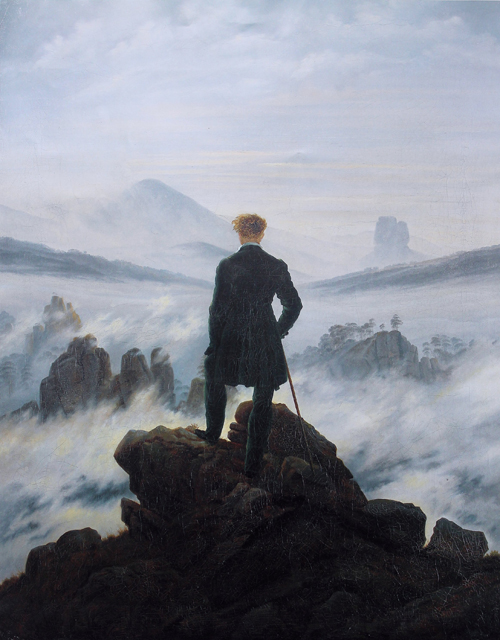
Wanderer above the Sea of Fog by Caspar David Friedrich

“Taxation of earnings is on a par with forced labour.” Robert Nozick in Anarchy, State and Utopia.

During a recent Salisbury Democracy Café the interesting question ‘Is Liberalism dead?’ was posed. Much depends on the definition of Liberalism. Some people seem to mean a rather wishy-washy tolerance epitomised by the pejorative term ‘bleeding heart liberal’. But political Liberalism is very far from being wishy-washy as the quote above by the American libertarian philosopher Robert Nozick attests. The most fundamental expression of this position is given by what is known as Methodological Individualism, which asserts that all attempts to explain social (or individual) phenomena are to be rejected unless they are couched wholly in terms of facts about the individual.

There have, however, been many attempts to create what might be called Social Liberalism, which in turn can be seen either as attempts to avoid Thomas Hobbes’s bleak conclusion that individuals should willingly submit to the power of a strong sovereign in order to protect them against a life that is ‘ nasty, brutish and short’, or the slide to Nozick’s extreme and equally unpleasant libertarianism. The social contract theory of Joh n Rawls in A Theory of Justice is probably the most influential work in the field. At the heart of this book is a kind of thought experiment he calls the Original Position or the Veil of Ignorance in which we are asked to imagine what sort of society would be chosen if we did not know certain facts about ourselves, particularly our social location and natural endowments. From this position Rawls deduces that most people would choose two principles: First – “Each person is to have an equal right to the most extensive total system of equal basic liberties compatible with a similar system of liberty for all”; second – “Social and economic inequalities are to be arranged so that they are both a) to be the greatest benefit of the least advantaged and b) attached to offices and positions open to all under conditions of fair equality of opportunity.”

One of the most serious objections to the Original Position coming from the communitarian tradition, however, is that it assumes a certain conception of the self as individuated before any sense of entanglement with social or communal considerations. This is a serious problem for those who believe that the creation of the self is inextricably linked to the collective, which itself is shaped by the individual. To the communitarian it makes no sense to assume that the individual springs fully formed from the womb without being at least partly shaped by its environment and communal links. From the political point of view this means that the individual emerges from and thrives in a communal environment in which certain universal goods like health, education and transport are communally pooled. And, as Erich Fromm wrote in Beyond the Chains of Illusion ‘the most important factor for the development of the individual is the structure and values of society into which he has been born’.

In this context, then, it could be argued that Rawls’s Original Position is an intellectually tortuous and, ultimately, unsuccessful device to save Liberalism from the bleak visions of Hobbes and Nozick or, indeed, an unsustainable reliance on an individualism cast adrift from its social grounding. And, of course, the same objections could be made against Nozick. It could be argued that communitarianism is a much more grounded vision of the individual and one that calls into question the fundamental principles of Liberalism, properly understood. Indeed, the individual cast adrift above Friedrich’s Sea of Fog may be a better metaphor than the Veil of Ignorance.

Avoiding the void!

“Thoughts are the shadows of our feelings – always darker, emptier, simpler.” Friedrich Nietzsche.

This is the first post on my new blog. I’m just getting this new blog going, so stay tuned for more. Subscribe below to get notified when I post new updates.

Paradoxically, the title of this blog may be misleading. It gives the impression that all that matters in life are…ideas. But is this true? The quote by Nietzsche above suggests otherwise. And, as David Hume wrote: “Reason is, and ought, only to be the slave of the passions, and so never can pretend to any office other than to serve and obey them.” OK, so Hume probably meant our senses rather than emotions, but you get the drift. Ever since the Enlightenment a battle has raged between Reason and Emotion, even though the Enlightenment has often been mischaracterised as privileging Reason over Emotion. In fact, it could be argued that many thinkers of the time acknowledged our dependence on Emotion but simply thought it might be a good idea to introduce a bit more Reason into the proceedings, thus freeing us from the most egregious slavery to Authority and Superstition.

In some ways this bifurcation of Reason and Emotion is mirrored in Cartesian duality of Mind and Body and in the political world of Community versus Individuality. Unless you are a follower of the idiocy of Neoliberalism in which the only interaction between individuals is transactional, many people feel a real tension between their individuality and their community. Are we forever condemned to two seemingly irreconcilable spheres or can they, indeed should they, be reconciled? In his remarkable book The Master and his Emissary, Iain Gilchrist argues that this division can be traced back to the Left and Right hemispheres of the brain. According to him the Right hemisphere is, or should be, the Master because it sees the world as an interconnected whole, while the Left sees it in discreet unconnected parcels, which it dissects, unpacks and logically analyses. Put simply, the Right unites and the Left divides. These two should, according to Gilchrist, work together with the Right (Master) passing its broad impressions to the Left (Servant) which, after its analysis, passes back to the Right in a classic one-two. The problem is, says Gilchrist, that the Left believes that it is in control and has increasingly become the Master with disastrous results.

An example of the problem might be the way that the Left recognises and conceptualises ethics that emerge from our interconnected Right. For example, many evolutionary biologists and neuroscientists think that altruism is a natural part of our genetic make-up. And since our genes can’t pretend to do anything for gain, this cannot be the oxymoron which is often referred to as reciprocal altruism, but genuine altruism. The Right hemisphere might intuitively acknowledge this, but think of altruism as part of the whole rather messy world of morality and human behaviour which, of course, includes selfishness and egoism. The Left hemisphere, however, may take altruism and turn it into a defined concept. That can be useful if it is then passed back to the Right hemisphere in order to transcend both to create an Hegelian synthesis. But what happens if it stays in the Left hemisphere? Well, according to Gilchrist, it can destroy ‘not just spontaneity, but the quality that makes things live; the performance of music or dance, of courtship, love and sexual behaviour, humour, artistic creation and religious devotion’ which ‘become mechanical, lifeless, and may grind to a halt’. Even if you understand the mechanics of interconnectedness and intersubjectivity, it can whither on the branch if it remains simply an idea or concept in the Left hemisphere and not lived, dynamically, in the Right. But if this happens, if indeed one grinds to a halt when, say, the dry altruism of the Left hemisphere judders to a halt in the face of mind-numbing indifference, how does one reconnect with the holism of the Right, which should be able to fill the inky black void?

Dickie Bellringer.

My First Blog Post

“Thoughts are the shadows of our feelings – always darker, emptier, simpler.” Friedrich Nietzsche.

This is the first post on my new blog. I’m just getting this new blog going, so stay tuned for more. Subscribe below to get notified when I post new updates.

Paradoxically, the title of this blog may be misleading. It gives the impression that all that matters in life are…ideas. But is this true? The quote by Nietzsche above suggests otherwise. And, as David Hume wrote: “Reason is, and ought, only to be the slave of the passions, and so never can pretend to any office other than to serve and obey them.” OK, so Hume probably meant our senses rather than emotions, but you get the drift. Ever since the Enlightenment a battle has raged between Reason and Emotion, even though the Enlightenment has often been mischaracterised as privileging Reason over Emotion. In fact, it could be argued that many thinkers of the time acknowledged our dependence on Emotion but simply thought it might be a good idea to introduce a bit more Reason into the proceedings, thus freeing us from the most egregious slavery to Authority and Superstition.

In some ways this bifurcation of Reason and Emotion is mirrored in Cartesian duality of Mind and Body and in the political world of Community versus Individuality. Unless you are a follower of the idiocy of Neoliberalism in which the only interaction between individuals is transactional, many people feel a real tension between their individuality and their community. Are we forever condemned to two seemingly irreconcilable spheres or can they, indeed should they, be reconciled? In his remarkable book The Master and his Emissary, Iain Gilchrist argues that this division can be traced back to the Left and Right hemispheres of the brain. According to him the Right hemisphere is, or should be, the Master because it sees the world as an interconnected whole, while the Left sees it in discreet unconnected parcels, which it dissects, unpacks and logically analyses. Put simply, the Right unites and the Left divides. These two should, according to Gilchrist, work together with the Right (Master) passing its broad impressions to the Left (Servant) which, after its analysis, passes back to the Right in a classic one-two. The problem is, says Gilchrist, that the Left believes that it is in control and has increasingly become the Master with disastrous results.

An example of the problem might be the way that the Left recognises and conceptualises ethics that emerge from our interconnected Right. For example, many evolutionary biologists and neuroscientists think that altruism is a natural part of our genetic make-up. And since our genes can’t pretend to do anything for gain, this cannot be the oxymoron which is often referred to as reciprocal altruism, but genuine altruism. The Right hemisphere might intuitively acknowledge this, but think of altruism as part of the whole rather messy world of morality and human behaviour which, of course, includes selfishness and egoism. The Left hemisphere, however, may take altruism and turn it into a defined concept. That can be useful if it is then passed back to the Right hemisphere in order to transcend both to create an Hegelian synthesis. But what happens if it stays in the Left hemisphere? Well, according to Gilchrist, it can destroy ‘not just spontaneity, but the quality that makes things live; the performance of music or dance, of courtship, love and sexual behaviour, humour, artistic creation and religious devotion’ which ‘become mechanical, lifeless, and may grind to a halt’. Even if you understand the mechanics of interconnectedness and intersubjectivity, it can whither on the branch if it remains simply an idea or concept in the Left hemisphere and not lived, dynamically, in the Right. But if this happens, if indeed one grinds to a halt when, say, the dry altruism of the Left hemisphere judders to a halt in the face of mind-numbing indifference, how does one reconnect with the holism of the Right, which should be able to fill the inky black void?

Dickie Bellringer.

Introduce Yourself (Example Post)

This is an example post, originally published as part of Blogging University. Enroll in one of our ten programs, and start your blog right.

You’re going to publish a post today. Don’t worry about how your blog looks. Don’t worry if you haven’t given it a name yet, or you’re feeling overwhelmed. Just click the “New Post” button, and tell us why you’re here.

Why do this?

  • Because it gives new readers context. What are you about? Why should they read your blog?
  • Because it will help you focus you own ideas about your blog and what you’d like to do with it.

The post can be short or long, a personal intro to your life or a bloggy mission statement, a manifesto for the future or a simple outline of your the types of things you hope to publish.

To help you get started, here are a few questions:

  • Why are you blogging publicly, rather than keeping a personal journal?
  • What topics do you think you’ll write about?
  • Who would you love to connect with via your blog?
  • If you blog successfully throughout the next year, what would you hope to have accomplished?

You’re not locked into any of this; one of the wonderful things about blogs is how they constantly evolve as we learn, grow, and interact with one another — but it’s good to know where and why you started, and articulating your goals may just give you a few other post ideas.

Can’t think how to get started? Just write the first thing that pops into your head. Anne Lamott, author of a book on writing we love, says that you need to give yourself permission to write a “crappy first draft”. Anne makes a great point — just start writing, and worry about editing it later.

When you’re ready to publish, give your post three to five tags that describe your blog’s focus — writing, photography, fiction, parenting, food, cars, movies, sports, whatever. These tags will help others who care about your topics find you in the Reader. Make sure one of the tags is “zerotohero,” so other new bloggers can find you, too.